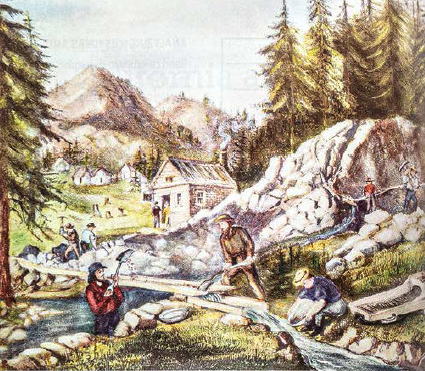
Most forty-niners had no experience in mining. Whenever
they heard that gold had been discovered at a particular site,
they rushed to it and attacked the hillsides with pickaxes and
shovels. They spent hours bent over streambeds, "panning" for
gold dust and nuggets. Panning involved gently swirling water
and gravel in a pan in order to remove dirt and, perhaps, reveal
a small speck of gold.
The California Gold Rush more than doubled the world's
supply of gold. For all their hard work, however, few forty-niners
achieved lasting wealth. Most found little or no gold. Many of
those who did find gold lost their riches through gambling or
wild spending.
Boomtown merchants, however, made huge profits. They could charge whatever they liked for food and other essential items because there were no other nearby stores that sold these products. Other merchants invented new products to meet new needs. For example, a Jewish German immigrant named Levi Strauss sold the miners sturdy pants made of denim. His innovative "Levi's" were "riveted for strength;" their popularity among the miners earned him a fortune.
BIOGRAPHY
CHARLEY PARKHURST
(1812-1879)
Charley Parkhurst was
a successful "whip" or
stagecoach driver. During
the Gold Rush, Charley
traveled to San Francisco
and eventually drove for
a stagecoach service.
A dangerous job, whips
faced mountainous terra i n,
storms, swollen rivers, and
bandits. Parkhurst lost an
eye after being kicked by
a horse, becoming known
as "One-Eyed Charley."
Railroads began tak i ng
over stagecoach routes,
so Parkhurst instead ran
a saloon/livery stable and
turned to logging and
farming. Charley died in
1879. As neighbors prepared the body for burial, they discovered that Charley was
female. Like some other
women of the t ime, Charlotte had transformed into a
man. Newspapers around
the country told Charley's
story. In the West, such
transformations may have
been made for a variety of
reasons. They gave women
economic opportunities
open only to men, or may
have enabled different
experiences or social
freedoms living as a man.
GOLD RUSH SOCIETY
Mining camps contained men of all backgrounds but few women. Lonely and suffering hardships, many men spent their
free hours drinking, gambling, and fighting. Mining towns had no police or prisons. As a result, citizens known as vigilantes (vih,juh•LAN,teez) formed committees to protect themselves. Vigilantes took the law into their own hands and acted as police, judge.jury, and sometimes executioner. One observer of vigilante justice was Louise Clappe, the wife of a doctor who lived in Indian Bar, a mining community on the Feather River. She wrote to her sister about a vigilante trial:
"By this time the exciting news had spread all over the Bar. A meeting of the
miners was immediately convened, the unhappy man taken into custody, a jury chosen, and a judge, lawyer, etc., appointed .... At one o'clock, so rapidly was the trial conducted, the judge charged the jury, and gently ins inuated (suggested) that they could do no less than to bring in with the irverdict of guilty a sentence of death' Perhaps you know that when a trial is conducted without the majesty of the law, the jury are compelled to decide not only upon the guilt of the pr i soner, but the mode of his punishment also. After a few minutes' absence. the twelve men, who had consented to burden their souls with a responsibility so fearful, returned, and the foreman handed to the judge a paper, from which he read the will of the people, as follows: That William Brown, convicted of stealing, etc., should, in one hour from that time, be hung by the neck until he was dead."-Louise Clappe, December 15, 1851
ECONOMIC AND POLITICAL PROGRESS
The Gold Rush had lasting effects on California. Agriculture, shipping, and trade grew to meet the demand for food and other goods. Many people who arrived looking for gold stayed to farm or run a business.
Rapid growth brought the need for better government. In 1849, Californians applied for statehood and wrote a constitution. The constitution's ban on slavery, however, caused a crisis in
Congress. Southern states opposed California's admission. Congress eventually worked out a compromise by which California became a free state in 1850.
CHECKING FOR UNDERSTADING
EXPLAINING CAUSES Which two pieces of legislation dealt with land rights of the Californios? Which of the two laws harmed those rights? Explain.
EXPLAINING EFFECTS How did the California Gold Rush lead to the expans ion of cities?
A RELIGIOUS REFUGE IN UTAH
GUIDING QUESTIONWhy did the Mormons settle in Utah?
While the Gold Rush was transforming California, change was also taking place in nearby Utah. There, Mormons, or members of the Church of Jesus Christ of Latter-day Saints, were building a new community and fulfilling their vision of the godly life.
THE MORMONS MOVE ON
The Church of Jesus Christ of Latter-day Saints was among a number of religious movements that sprang up during the religious awakenings of the 1830s and 1840s